

Bawse
Owner
Staff member
Admin
 StockPoker June 2026 Leaderboard Gold
 Shark Tank May 2026 Leaderboard Silver
 StockPoker May 2026 Leaderboard Silver
StockPoker April 2026 Leaderboard FInals Gold
StockPoker April 2026 Leaderboard Gold
StockPoker May 2026 Leaderboard Silver
StockPoker April 2026 Leaderboard FInals Gold
StockPoker April 2026 Leaderboard Gold
 Shark Tank March 2026 Leaderboard Gold
Shark Tank January/February 2026 Finals Gold
StockPoker January 2026 Leaderboard Finals Silver
StockPoker November 2025 Leaderboard Finals Silver
StockPoker February 2026 Leaderboard Gold
Shark Tank March 2026 Leaderboard Gold
Shark Tank January/February 2026 Finals Gold
StockPoker January 2026 Leaderboard Finals Silver
StockPoker November 2025 Leaderboard Finals Silver
StockPoker February 2026 Leaderboard Gold
 PCF Poker Mania Winner
StockPoker December 2025 Leaderboard Gold
PCF Poker Mania Winner
StockPoker December 2025 Leaderboard Gold
- Joined
- Jan 22, 2024
- Messages
- 3,805
- Reaction score
- 1,289
- StockPoker Screen Name
- BawseGrind1
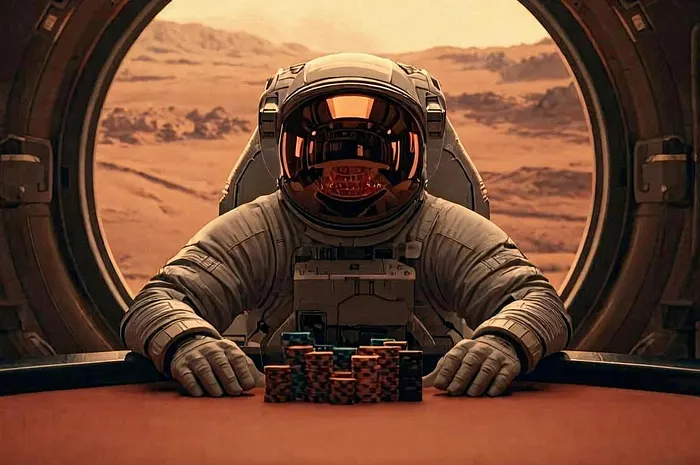
Poker and Texas are practically joined at the hip. It says so right there in the name: Texas Hold’em.
The story of poker in the Lone Star State began with legendary road gamblers like Doyle Brunson, Amarillo Slim, and Sailor Roberts playing on the notorious Exchange Street in Fort Worth, and continues to this day with modern poker rooms such as The Lodge and Prime Social.
But just 30 miles away from Texas’s poker heartland, at Johnson Space Center, poker is playing an unlikely part in humanity’s pursuit of the stars.
When the Space Race Met the Card Table
A simple search for poker and NASA, will easily bring up the Poker Flat Research Range in Alaska, a launch site for scientific rockets, but poker’s role in NASA’s culture stretches much further. The connection between poker and space exploration goes back far longer than most people realiz.When Sputnik 2 launched in 1957, engineers at the Jet Propulsion Laboratory in Pasadena redoubled their efforts to send America’s first satellite into orbit. The team dubbed the effort Project Deal, named after the all-night poker games that engineers played on the long drives to the White Sands testing grounds in New Mexico. Project manager Jack Froehlich, himself a keen player, often joked: “When a big pot is won, the winner sits around and cracks bad jokes and the loser cries, ‘Deal!’”
NASA would eventually build a “virtual lunar landscape” in the Nevada desert, just 65 miles north of Las Vegas, where eleven of the twelve men who walked on the Moon were trained, rehearsing sample collection and rover driving in the desert environment.
And when Apollo 11 returned to Earth, the poker tradition followed them into quarantine. Concerned that lunar rocks might contain unknown microbes, NASA kept the crew isolated for two weeks. During this, NASA’s Wilmot Hess later recalled, they spent the time “drinking bourbon and playing poker and whatnot, and having a good time.”
Life Inside the Mars Dune Alpha
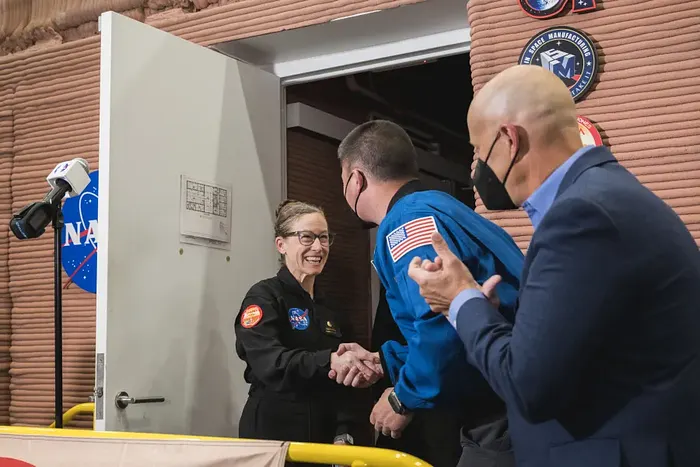
Nowadays, however, within Building 220 of Johnson Space Center, sits the next stage in NASA's pursuit of the stars. The Mars Dune Alpha is a 1,700-square-foot, 3D-printed habitat that houses NASA’s Crew Health and Performance Exploration Analog (CHAPEA). It’s home to the most realistic and comprehensive Mars mission simulation ever conducted on Earth.The first CHAPEA mission ran from June 25, 2023, to July 6, 2024, with Commander Kelly Haston leading her crewmates Flight Engineer Ross Brockwell, Science Officer Anca Selariu, and Medical Officer Nathan Jones through 378 days of isolation.
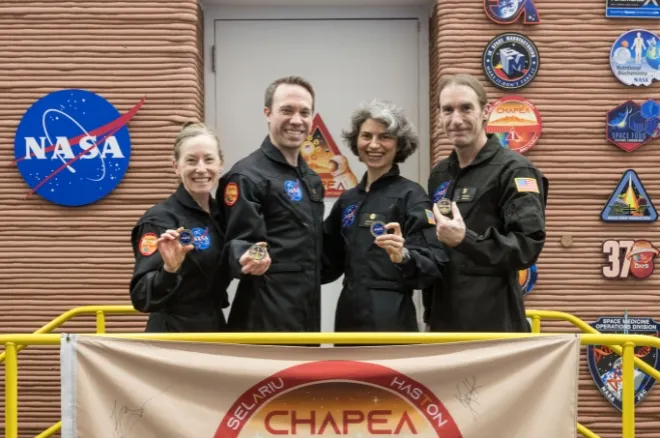
Inside Mars Dune Alpha, realism was everything. The crew knew they were inside a 3D-printed structure in a hangar outside Houston, but NASA’s goal was to make them feel as if they were truly on Mars.
"There was a lot of realism built into all of the different aspects," Commander Haston told PokerNews. "As an adult, you can't really pretend your way out of ‘I’m in a box in Houston,’ right? But you can live the moment of, 'I don’t get to speak to my partner for a year. I don’t get to speak to anyone else but these three people for a year.' And that is still an extreme isolation situation.""As an adult, you can't really pretend your way out of ‘I’m in a box in Houston'"
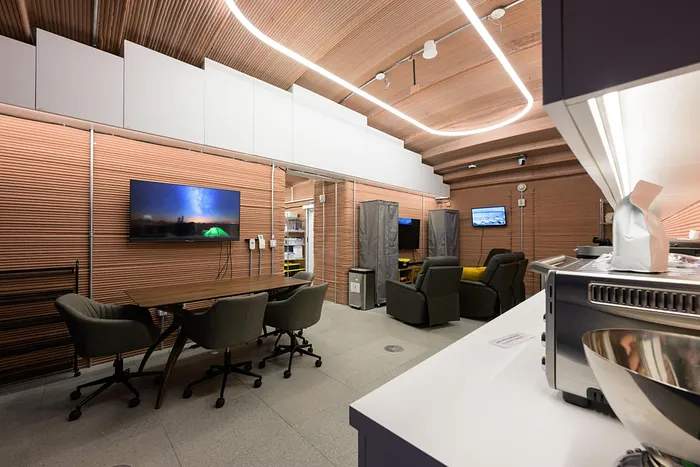
The habitat was sound-dampened to block out external noise, communications with “Earth” were delayed to mimic the real-time lag of interplanetary contact, and resupply tasks were carefully staged to simulate Martian logistics. Every detail, from rationed cleaning supplies to daily exercise prescriptions, was designed to test how humans would cope with isolation, scarcity, and monotony on another planet.
"We exercised for maintenance, not for whatever you felt like on a given day,” Haston explains. “We had a prescription every single day from the exercise experts at NASA, and if I went off script, I was messing with their experiment. One day, I did exercise off script, and I immediately got a letter asking what had happened.”
According to Grace Douglas, CHAPEA principal investigator, the mission aims to gather data that will be necessary for future Mars missions. This included performance and health-related information, as well as tracking nutrition and exercise and collecting cognitive data from each crew member.
The Cards That Kept Them Human
Beyond the strict schedule, downtime proved just as important. Inside Mars Dune Alpha, relaxation came in the form of video games, movies, and — perhaps unexpectedly — poker.Every item inside Mars Dune Alpha had to earn its place. Just like a real space mission, the CHAPEA crew operated under strict payload limitations, with every kilogram of mass logged, justified, and approved. Even personal items were weighed against scientific value and psychological benefit.
"We brought games in, and our families were given a very small allocation of weight for basically the smallest gift possible. As a crew, we had to do things together with limited resources. There's not much smaller or more compact than a pack of cards, right? And NASA knew this, so they absolutely gave us cards! ""There's not much smaller or more compact than a pack of cards, right? And NASA knew this, so they absolutely gave us cards!"
As a result, poker became a big part of how Haston and the crew bonded during their time together. According to NASA’s 'Houston We Have a Podcast', a long-running game of Texas Hold'em started up, ultimately lasting 10 months, with Medical Officer Nathan Jones the eventual winner.
"Honestly, other than myself, because I'm really crap at poker," said Haston. "I would say that every single person looked like they were going to win at one point. The game really waxed and waned, and it was a very exciting slow burn.
“We didn’t have chips, so we used these little colored reagent caps. Eventually, we ran out of them to use in the experiments because we’d repurposed them for poker!"
For the crew, although poker may have started out as simply entertainment, it quickly formed a vital psychological tool.
"It was incredibly important for us," says Haston. "In future missions, it's going to be incredibly hard to maintain relationships with people when you're that far away for that long. After we had said all the things to each other that you can imagine saying, and you've exhausted all talking points because new information from the outside was so limited, we only had so much to offer each other by the end of the mission.
"Games were a way for us to continue to build new storylines and have funny things happen. They were essential. To me, poker and games are going to be incredibly important as we build the community between Earth and wherever we are in space. It's a way for people to really maintain their relationships and have something to do together."
"It was a unique experience. It was definitely a real challenge, but there are so many good memories too. And the poker was definitely really fun."
Read more/Source: https://www.pokernews.com/news/2025...ng-nasa-astronauts-prepare-for-mars-49960.htm


